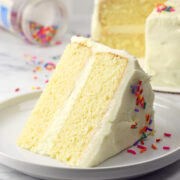
Vanilla Layer Cake
Vanilla layer cake is a tender, moist, and buttery two-layer cake topped with vanilla buttercream frosting. It's perfect for birthdays and celebrations!
Servings 16 or more servings
Ingredients
Cake
- 1 cup (226 g) unsalted butter room temperature
- 1 ¾ cups (345 g) granulated sugar
- 1 tablespoon vanilla extract
- 4 large eggs room temperature
- 3 cups (336 g) cake flour measured properly*
- 1 tablespoon baking powder
- ¾ teaspoon salt
- 1 cup (227 g) whole milk room temperature
Frosting
- 1 cup (226 g) unsalted butter room temperature
- 4 cups (454 g) confectioner's sugar
- ⅓ cup (75 g) heavy cream
- 2 teaspoons vanilla extract
- ⅛ teaspoon salt
Instructions
Vanilla Cake
- Preheat oven to 350℉. Generously grease and flour two 8-inch or 9-inch round cake pans, optionally lining the bottoms with parchment circles, and set aside.
- In a large bowl, add room temperature butter and granulated sugar. Beat until creamed and fluffy, about a minute. Add vanilla and eggs, one at a time, mixing until incorporated and smooth.
- In a separate bowl, sift together dry ingredients: cake flour, baking powder, and salt.
- Add half of the dry ingredients to butter mixture. Mix until just combined. Add half of milk, again mixing until just combined. Repeat once more to add remaining dry ingredients and milk.
- Pour batter evenly between two round cake pans and spread into an even layer.
- Two 9 inch round cake pans: 26-30 minutesTwo 8 inch round cake pans: 28-34 minutesBake your cake using the times listed above as an estimate, or until cake is baked through in the center. If your cake jiggles in the middle, it needs more time. If cake is not jiggly, gently press into the center with a finger. If an indent is left, your cake is not done. If cake springs back, it's done. Ovens can run hot, so I suggest using visual cues and not relying on time alone.
- Remove cake from oven and allow to cool completely in the pan(s) on a wire cooling rack.
Frosting
- In a large bowl, add room temperature butter and beat until creamy. Add confectioner's sugar and slowly mix until ingredients are fully combined. Then, whip at high speed for 2-3 minutes, or until light and fluffy.
- Add heavy cream, vanilla extract, and salt. Whip for an additional 2-3 minutes, or until light and fluffy. Add additional heavy cream as needed to reach desired consistency.
- Gently flip and remove cakes from their pans. Trim the rounded tops with a serrated knife to make flat layers.
- Place one layer onto a cake stand or plate. Top with frosting in an even layer. Add second layer of cake and top with another layer of frosting. Spread remaining frosting onto the sides of the cake.
Video
Notes
- Measuring flour: * Use a kitchen scale for accurate results. If you don't have a kitchen scale, use the spoon and level method. Stir the flour (especially if it's been packed down in a bag/container), then gently spoon into the measuring cup, leveling off the top with a knife. Scooping with a measuring cup compacts flour into the cup and adds up to 25% extra to the recipe, resulting in dry, bland cake.
- Do not refrigerate your cake: Butter-based cakes harden in the refrigerator and will feel dry (until they come back to room temperature). Only refrigerate a cake if your home is very hot (reaching 90F or hotter) and your cake is in danger of melting.
- Storage: Unfrosted or frosted cake will keep in a sealed container at room temperature for 2-3 days, or frozen for up to 2 months. If refrigerating or freezing unfrosted cake layers, wrap tightly in plastic and place in a tightly sealed container. Thaw overnight in the refrigerator, then bring to room temperature for an hour before serving.
- More tips: Be sure to check out my 10 tips for baking cake, based on reader comments and questions!
Nutrition
Serving: 1slice | Calories: 357kcal | Carbohydrates: 47g | Protein: 3g | Fat: 18g | Saturated Fat: 11g | Polyunsaturated Fat: 1g | Monounsaturated Fat: 5g | Trans Fat: 1g | Cholesterol: 73mg | Sodium: 103mg | Potassium: 101mg | Fiber: 0.4g | Sugar: 35g | Vitamin A: 578IU | Vitamin C: 0.02mg | Calcium: 48mg | Iron: 0.3mg
