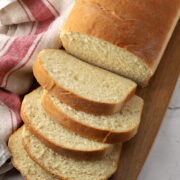
Overnight Sandwich Bread
Overnight sandwich bread is made with just seven simple ingredients and turns out fluffy and tall with a golden crust. The dough can be refrigerated overnight for fresh-baked bread on your schedule.
Servings 15 slices
Ingredients
- 1 cup (240 g) water
- ¼ cup (60 g) whole milk
- ¼ cup (56 g) unsalted butter sliced into pieces
- 3 tablespoons (37 g) granulated sugar
- 1 ½ teaspoons (5 g) instant yeast
- 3 ⅓ cups (400 g) bread flour or high protein AP flour*
- 2 teaspoons (6 g) kosher salt
Instructions
- In a microwave safe bowl, add water, milk and butter pieces. Microwave in 20 second increments until butter has melted and mixture is warm to the touch, but not hot (about 110℉).
- Whisk in sugar and yeast and allow to rest for about 5 minutes. Mixture will look foamy and bubbly. (If it's not foamy after 10 minutes, your yeast may be expired.)
- Meanwhile, add flour and salt to a large bowl. Once ready, add yeast mixture to the bowl and stir with a wooden spoon until a sticky dough forms.
- Turn dough out onto a lightly floured surface. Using floured hands, knead the dough for 3-5 minutes. Dough will look smooth, slightly tacky, and slowly springs back when gently pressed. (See notes below for stand mixer directions).
- Transfer dough to a lightly greased bowl, tossing dough to coat all sides, and cover with plastic wrap or an airtight lid. Allow to rise for about 1 hour at room temperature, or until doubled in size.
- Punch dough down and turn out onto a lightly floured surface.
- Pat dough into a rectangle, then roll up into a log, pinching the seams closed.
- Transfer loaf, seam side down, into a greased 8.5x4.5 loaf pan (or 9x5 loaf, or 9x4 pullman pan).
- Overnight: Cover with plastic wrap (allowing space for the dough to expand) and transfer to the refrigerator overnight (up to 3 days).Same day: Cover with plastic wrap and allow to rise for about 1 hour. Test dough by pressing with a finger. If it slowly springs back about halfway and feels jiggly and airy, it's ready. If dough springs back quickly and feels dense, it needs more time.
- Preheat oven to 350℉. If your dough is refrigerated, set pan on the counter while the oven preheats.
- Transfer loaf to the oven and bake for about 40-45 minutes if refrigerated overnight (30-35 minutes if same day), or until the center reaches 195℉. Tent your loaf with foil if the top is browning too quickly.
- Rest bread for a few minutes before popping out of the pan and transferring to a cooling rack (this ensures the bread doesn't get soggy while cooling in the pan). Allow to cool completely before slicing and serving.
Video
Notes
- *Flour variations: This recipe works best with bread flour, but an AP flour with higher protein content (like King Arthur) can also produce great results. Low protein flours like cake flour or white lily flour are not recommended.
- Yeast: This recipe can be prepared with instant or dry active yeast. If using dry active yeast, your rise times will take slightly (15-20 minutes) longer.
- Stand mixer directions: Add ingredients to the bowl of a stand mixer fitted with a paddle attachment or dough hook. Mix on low until a soft, sticky dough forms. Beat on medium speed until the dough starts to pull away from the sides of the bowl (this takes about 2 minutes). If dough looks wet and sticky, add more flour, 1 tablespoon at a time, until dough comes together and looks soft and slightly tacky, not sticky. Beat for an additional 5 minutes. Dough should feel soft and slowly bounce back when pressed.
- How long can dough rest in the refrigerator?: Enriched dough will keep for up to 3 days in the refrigerator before baking.
- Storage: Keeps 2-3 days at room temperature, frozen for up to 3 months.
Nutrition
Serving: 1slice | Calories: 145kcal | Carbohydrates: 23g | Protein: 4g | Fat: 4g | Saturated Fat: 2g | Polyunsaturated Fat: 0.3g | Monounsaturated Fat: 1g | Trans Fat: 0.1g | Cholesterol: 9mg | Sodium: 237mg | Potassium: 52mg | Fiber: 1g | Sugar: 3g | Vitamin A: 102IU | Vitamin C: 0.01mg | Calcium: 11mg | Iron: 0.3mg
